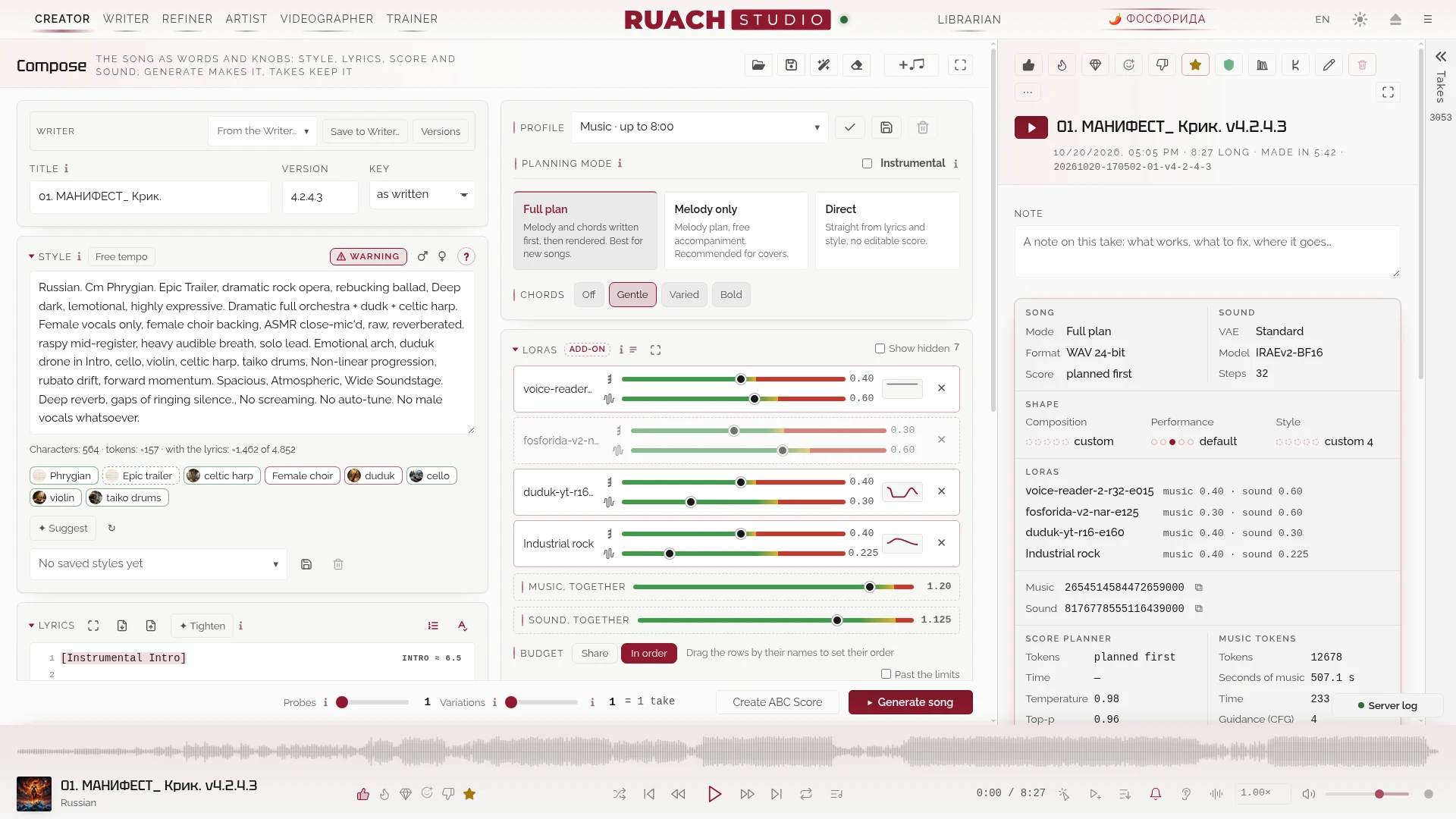
Creator
Style, lyrics, planning mode, decoder, LoRAs on a road from green to red; the take with its score, seeds and everything to make it again.
A whole studio around YuE2, the open song model. Write the style and the lyrics, and the Studio composes, sings and renders the song on your own GPU. Your songs, words and settings never leave it.
2.0.5 · every peak whole, the family tree and the Studio over https · November 2026
Ruach Studio is open music generation that runs on your own hardware: the model, the score, the adapters and every take stay yours, and nothing is rented by the token. Open models are now good enough to stand on their own, and what was missing is the Studio around them: that is what we build, in the open.
Music should be free to make and to share: whoever has no voice, no instrument and no studio still has the right to lay their thoughts and feelings onto sound.
The Creator makes the song, the Writer writes it with a chat model, the Refiner finishes it, the Artist paints its pictures, the Videographer plans its music video, the Librarian keeps every take, and the LoRA Trainer teaches YuE2 your own songs. A guide for every room is inside the Studio.
Style, lyrics, planning mode, decoder, LoRAs on a road from green to red; the take with its score, seeds and everything to make it again.
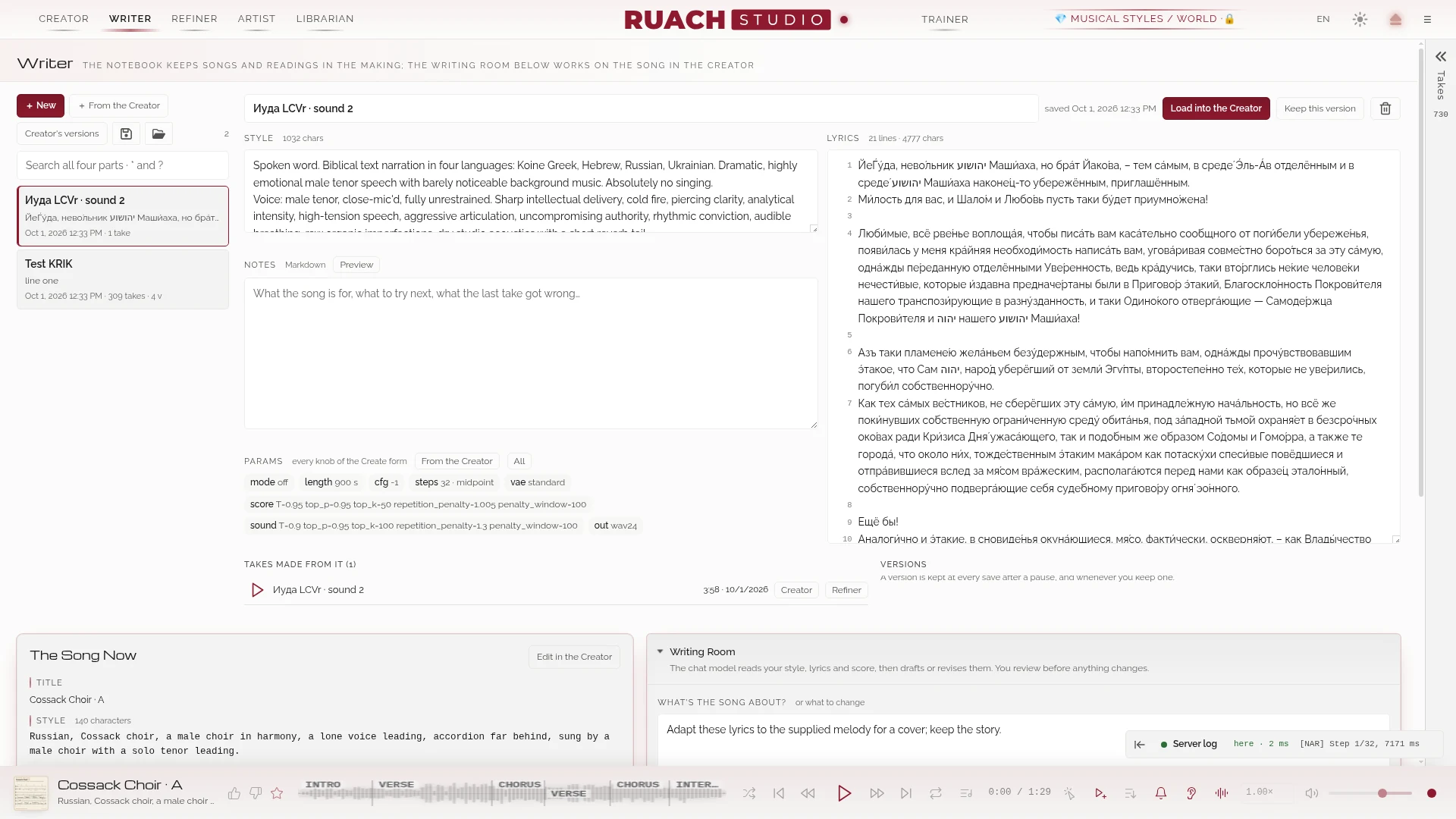
Songs as documents with versions, text profiles, and a chat model of your own (or OpenRouter) that drafts and revises with you.
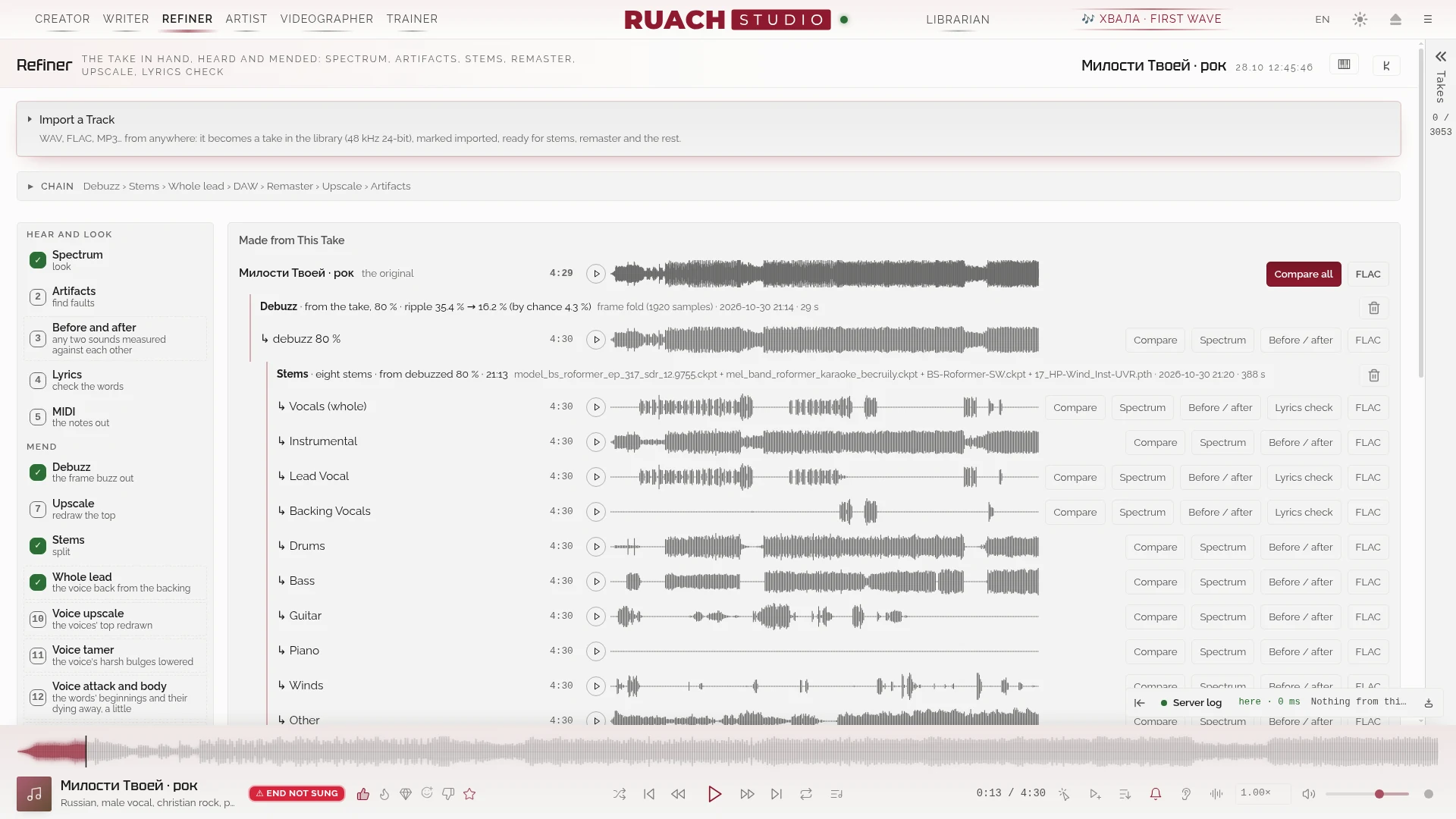
Spectrum, artifacts, debuzz, a lyrics check by Whisper, stems, remaster, upscale; one chain runs them all.
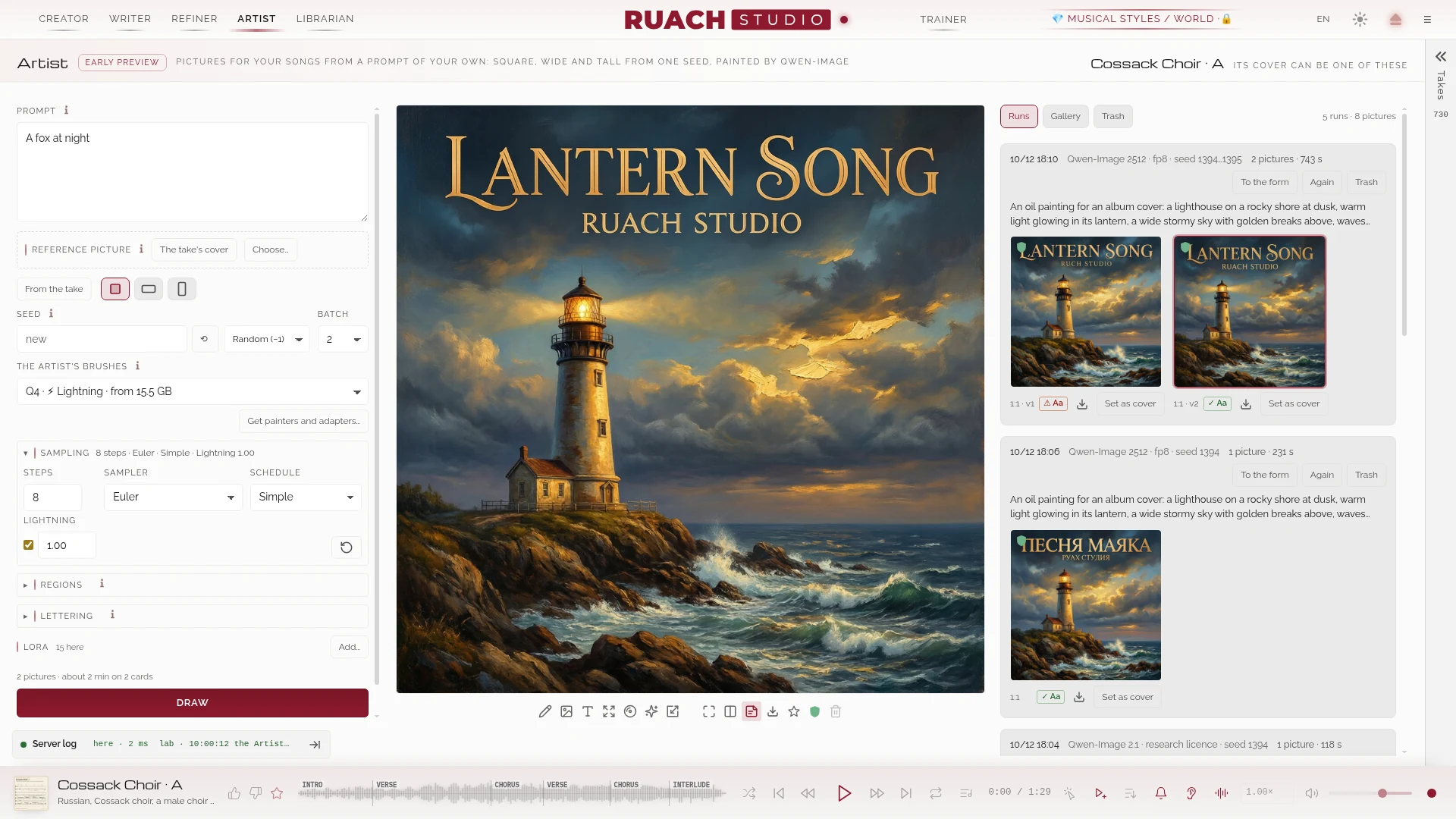
Pictures for your songs from a prompt of your own: square, wide and tall from one seed, painted by Qwen-Image 2512; the picture develops before your eyes, and a square one becomes the take's cover. An early preview.
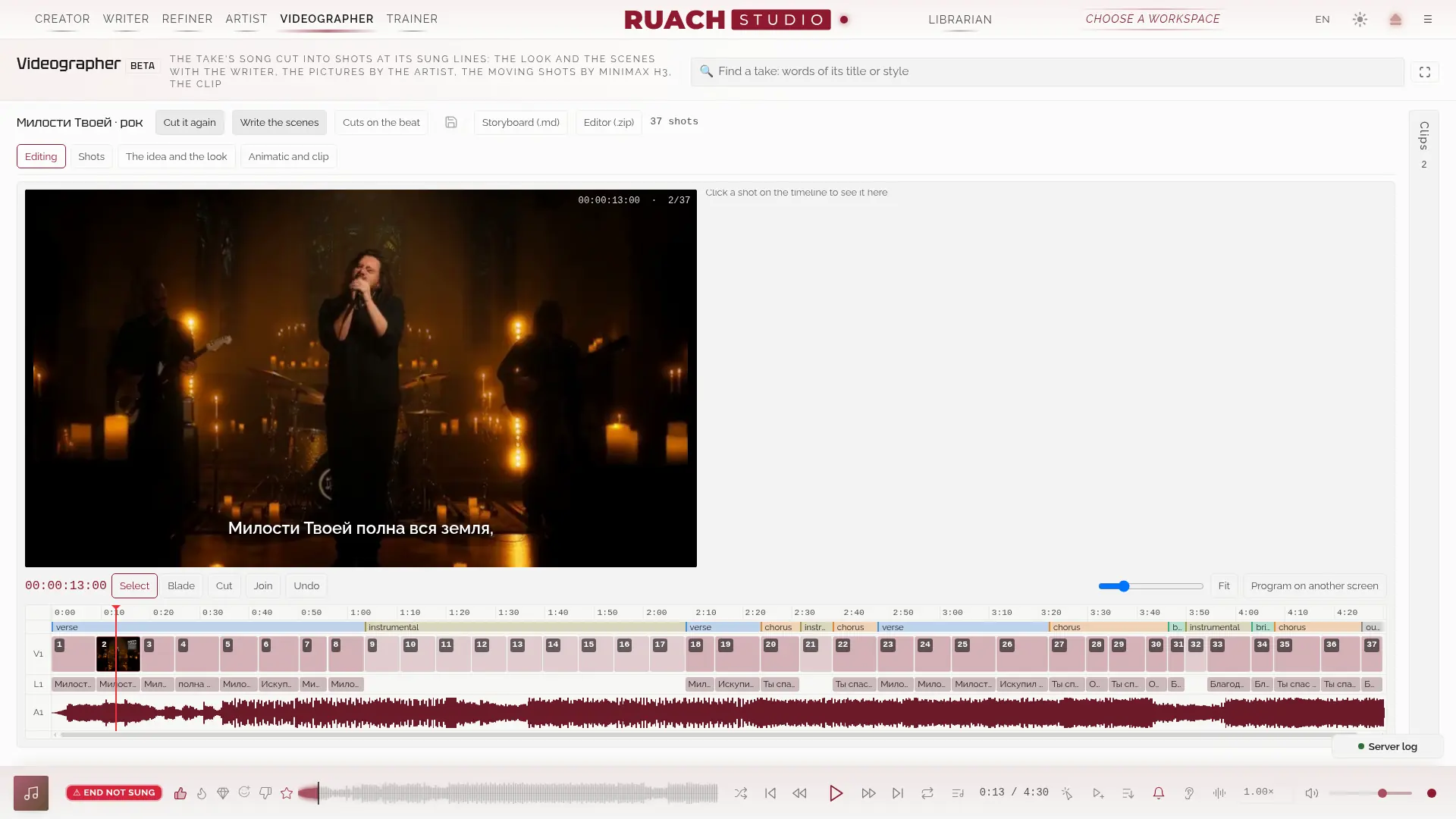
A music video for the take: its song cut into shots at the sung lines, the scenes written with the Writer, the key frames painted by the Artist, the moving shots by MiniMax H3; a timeline to edit, a look (3D LUTs, grain), an animatic and the clip. Beta.
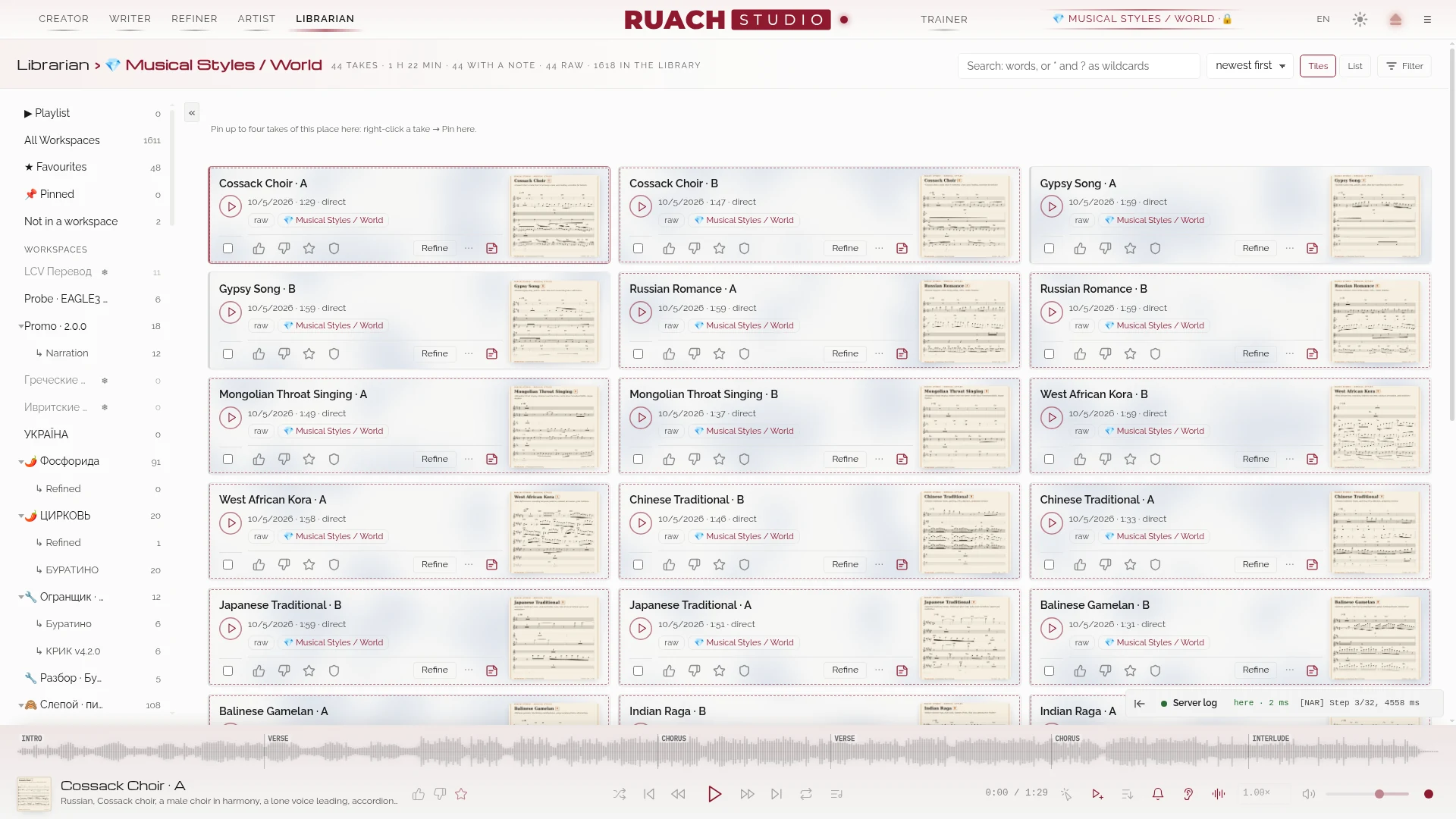
Every take in workspaces: searched, liked, noted, locked, given artwork, sent to your DAW; a trash that gives back.
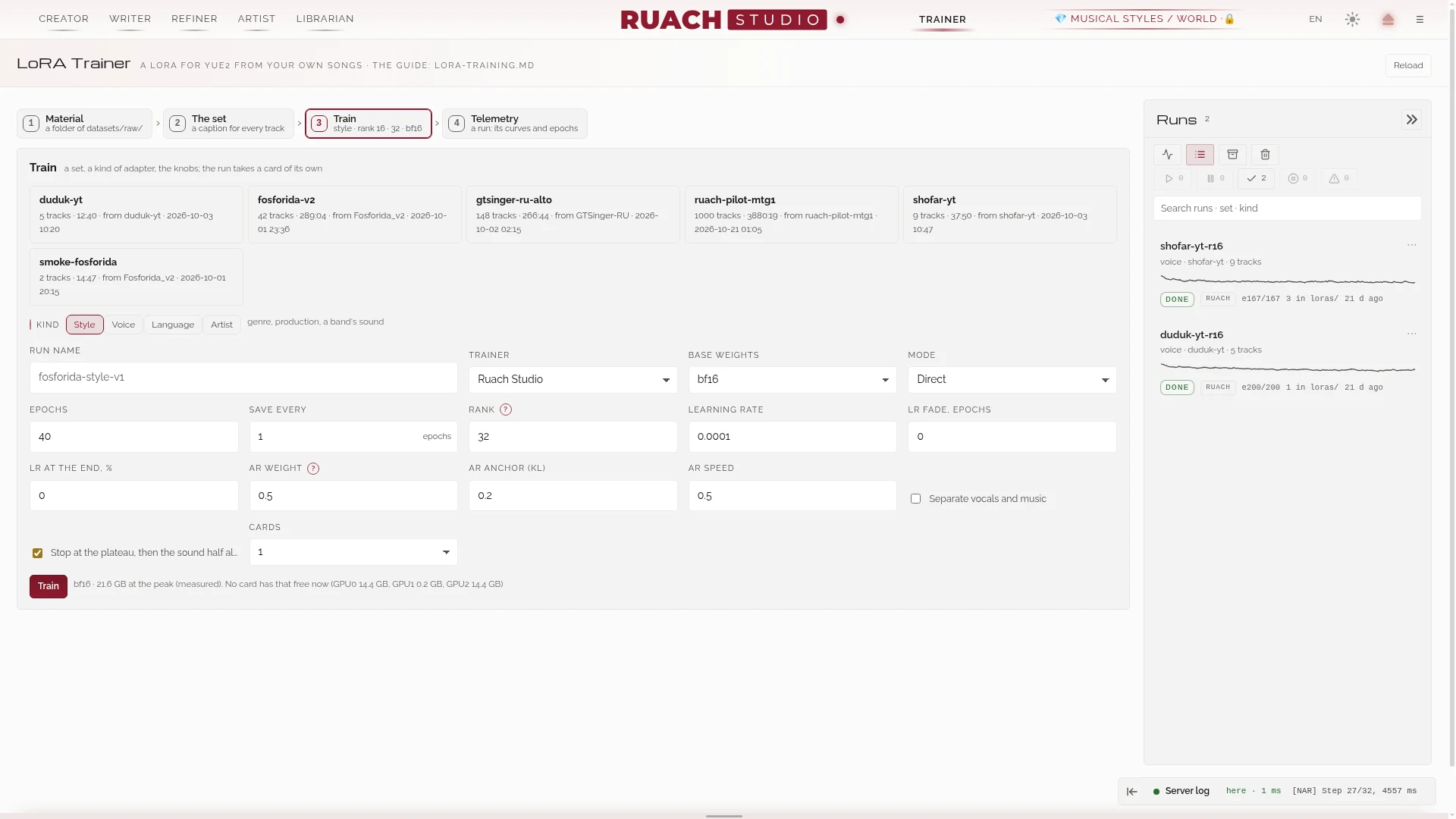
Adapters from your own songs: the set, the run, both halves' curves explained, the epochs worth hearing first.
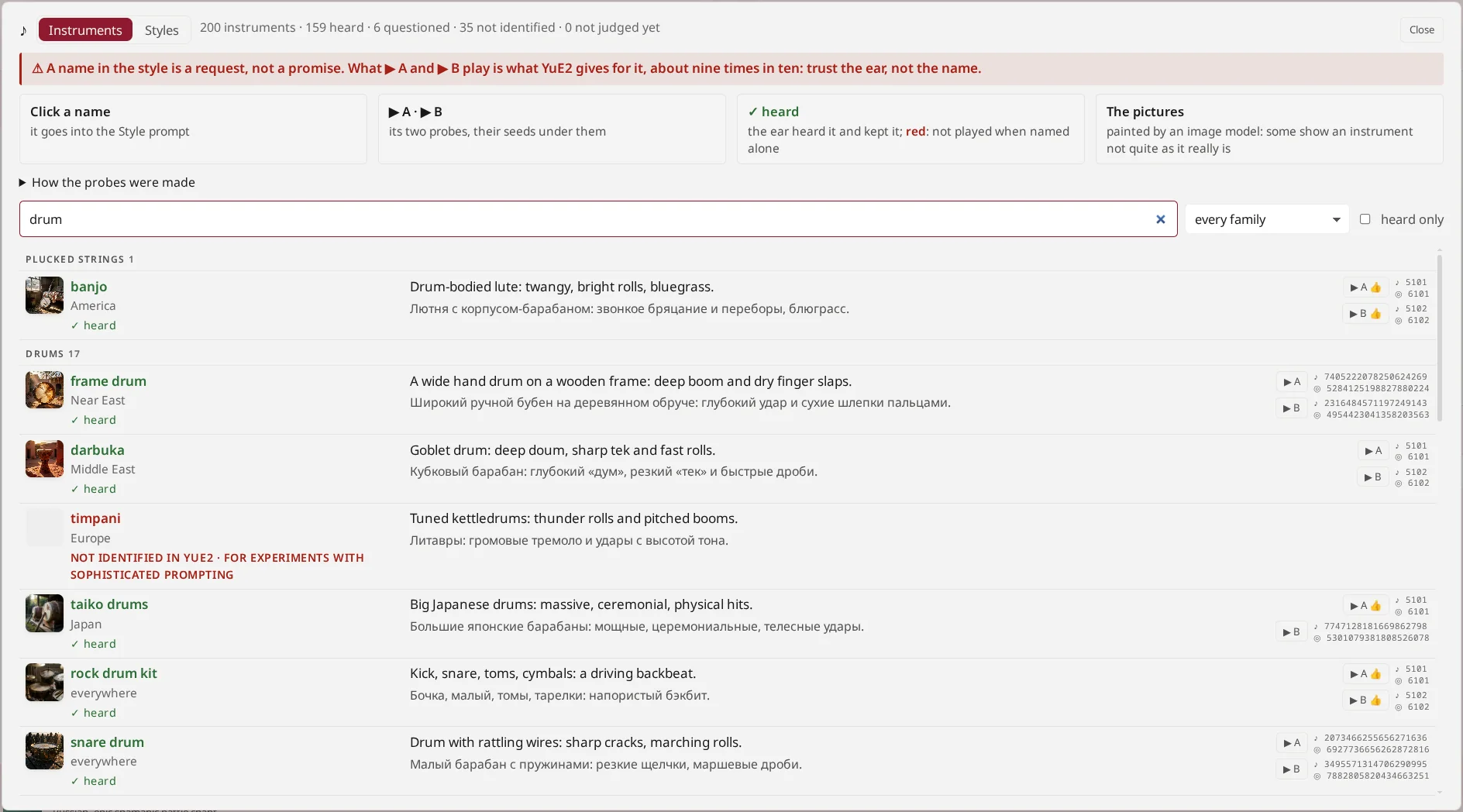
200 instruments probed and judged by ear: what YuE2 really plays, what it plays thinly, what it does not know.
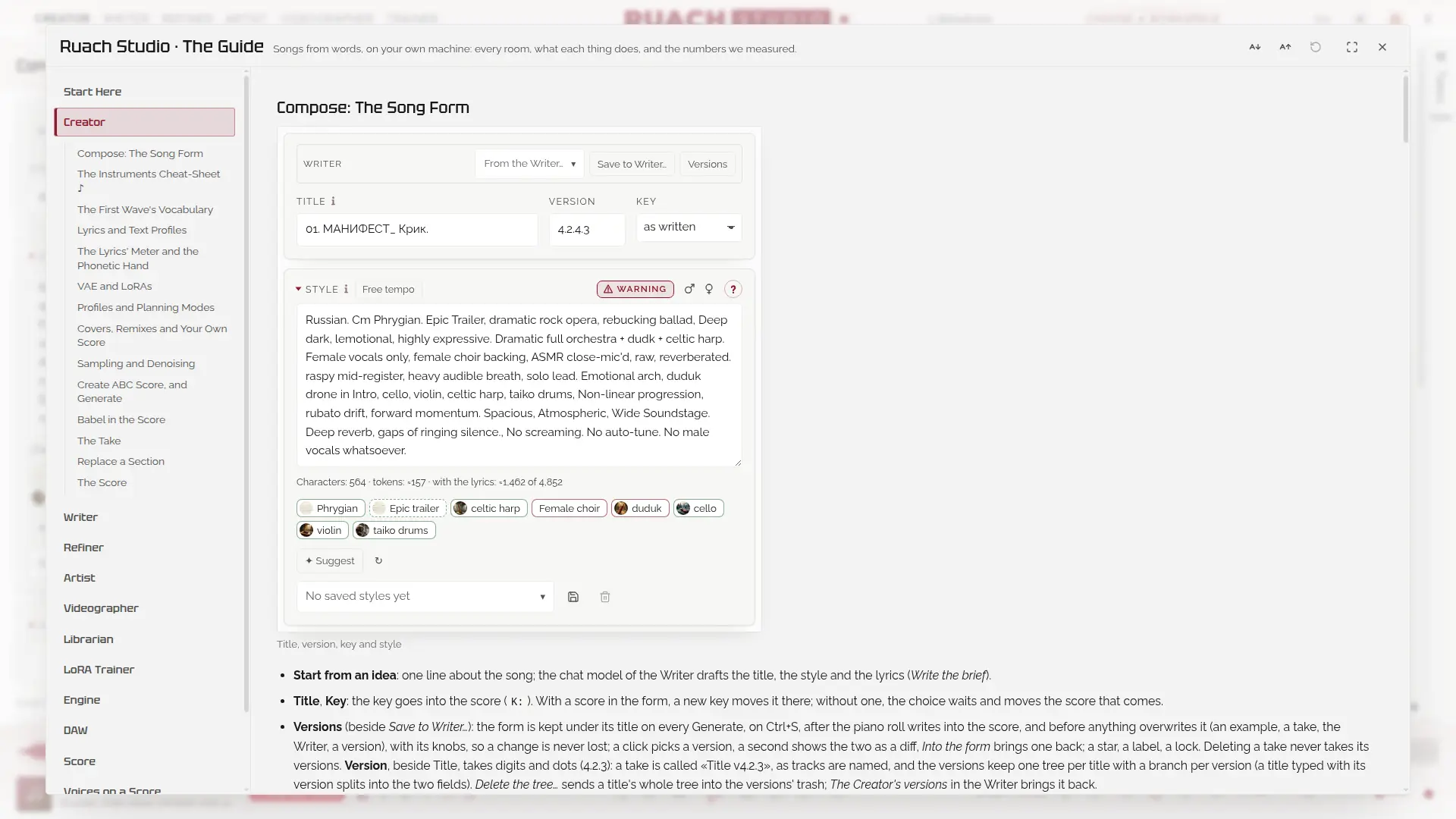
The whole Studio explained inside the Studio, a key away: every room and every knob, what it does and the numbers we measured, in twelve languages. Made for the joy of making, not for hours of searching the web.
Not one more model wrapper: a workstation around the model, open to the bone, every change numbered and documented.
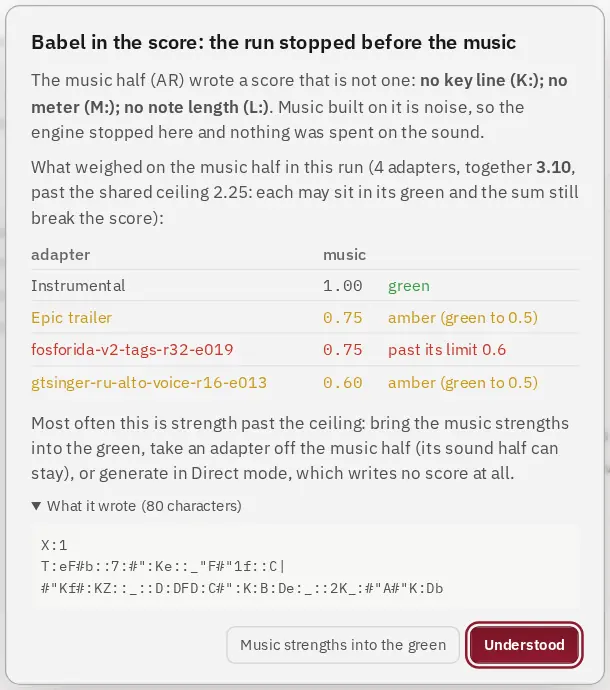
When the music half writes a broken score (adapters pushed too far do that), the engine stops the run before any music is built on it, in seconds, and says why: which adapters, how far past their limits, what was written.
Strengths sit on measured roads; stacked adapters share a measured ceiling.
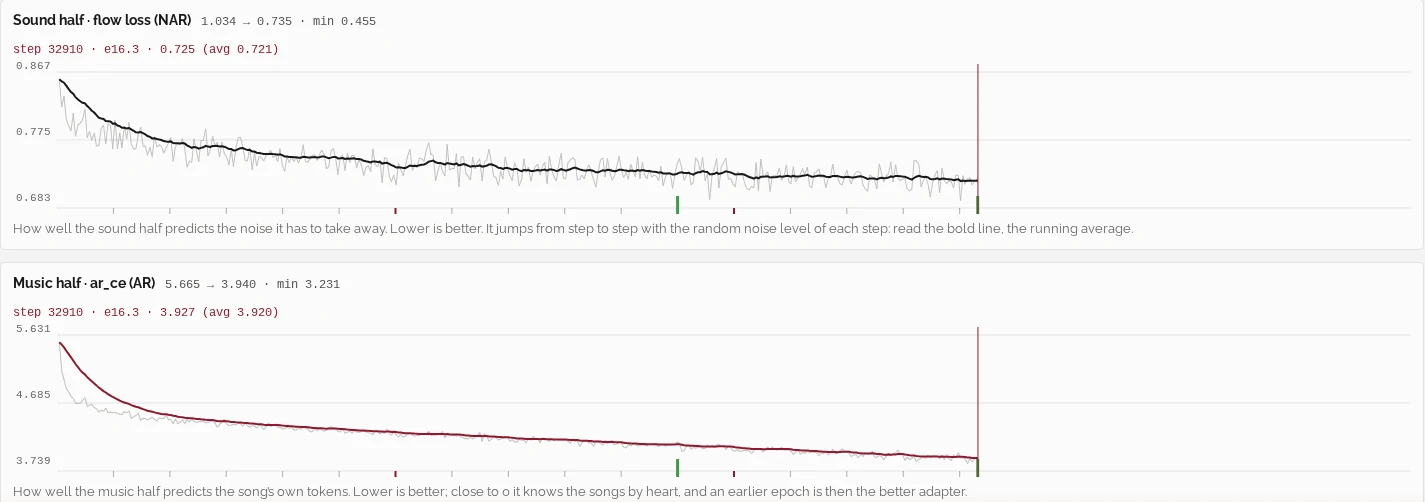
The Studio trains adapters itself, on unquantized bf16 weights. Against Ostris' AI-Toolkit on the same set, the music half's loss agrees epoch by epoch within 0.015.
Rank 16 on 148 songs: 2.1 s a step in 12 GB. Rank 32 on 42 full songs: 6.7 s a step in 18 GB.
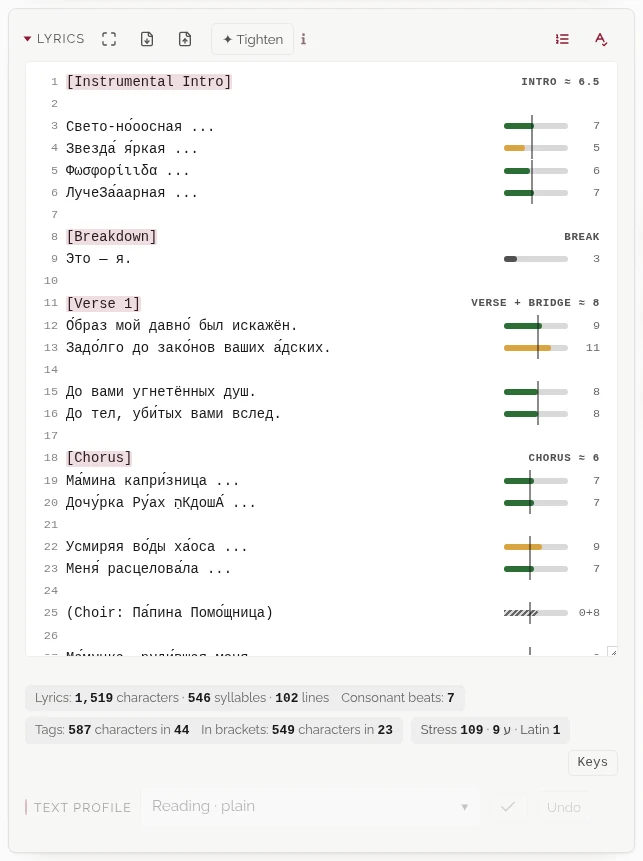
Beside each line its beats, against the ruler of its section: verse and bridge one group, the pre-chorus and the chorus their own. A syllable is counted by each language's own rules, and the consonants that take a beat of their own count too; a pause or an interlude inside a section opens no new group.
Type «[» at a line's start and the section tags are offered, as a code editor offers its words. Stress marks astray are found; Ctrl+F finds in the box alone.
Every week a video says some model kills SUNO. This is not a model: it is a whole studio around one, with a fine-tune of its own. Where it wins, and where SUNO still does, said plainly.
| Ruach Studio (YuE2) | SUNO | |
|---|---|---|
| where it runs | your GPU; your songs, words and settings never leave it, and once installed it needs no internet | their cloud |
| what it costs | the electricity: no credits, no plans, no daily limits | a subscription and credits |
| the model | YuE2 and our own fine-tune, RS-FW, the first large open one: both halves taught again on 32,633 tracks, about 1,800 hours, and every word they were told published | closed; what it learned from is not published |
| the score | written first, shown, editable, yours (ABC, MIDI); a piano roll over the whole window | hidden |
| the lyrics | a meter beside each line: its beats against its section's ruler, syllables by each language's own rules; the section tags offered as you type «[» | a text box; lyrics written for you on request |
| repeat a take | exactly: two seeds you keep | no |
| guidance | two, apart: the style's pull and the lyrics' hold, each its own CFG | one Style Influence knob |
| replace a section | its words sung anew between the rests the ear finds, the rest of the take kept to the sample: the seam goes unheard; several sections in one go | Replace Section: in our trials almost never usable, the seams heard and the voice changed |
| a take's family | a family tree: every crop, version and regeneration a take came from and what came of it, each with its wave | — |
| the library | workspaces with sections, sixteen reactions, notes, protection and a trash that gives back, a search with wildcards and «not», blind sets for honest listening, a leaflet and a passport for every take | workspaces, likes and playlists |
| comparing takes | up to twelve versions in one player from the same second, named or blind, at equal loudness, aligned by their own sound | — |
| your own sound | train a LoRA on your songs, in the Studio | no training; Personas reuse a song's voice and style |
| what YuE2 cannot play | a MIDI orchestra on the take's own score (SFZ sets, and Pianoteq if you own it), and nature laid under the song: fire, rain, rivers, birds | — |
| your own instruments | the Bank Builder turns recordings of one instrument (a duduk, a shofar) into an SFZ bank: voices, shouts and other instruments heard out, the notes found key by key, tuned and looped; in the DAW it plays under the song as a bed, a drone in its key or a MIDI line | — |
| every peak whole | no clip at the output: long reverb tails and the quiet stay whole; the family tree shows where the old cut would have bitten | delivered mastered (in our ring: −15.5 LUFS, −3.4 dBTP) |
| after the render | stems, debuzz, remaster, upscale, a lyrics check and a master against a loudness target (Spotify −14, Apple Music −16, a CD −9), all local | stems and a remaster, in the cloud |
| a mixer | a DAW in the Refiner: lanes with EQ, gate, compressor, width and sends, automation, markers, a lane's sound kept as a preset | Suno Studio, in the browser, on its top plan |
| seeing the sound | the take's whole spectrogram over the player, in time with its wave: the sections, the brightness and loudness, the spectrum and note under the pointer | a waveform |
| pictures and video | the Artist paints the cover, the 16:9 and the 9:16 from your words; the Videographer plans the music video, paints its key frames and gives it a look (3D LUTs, grain, vignette) | a cover image |
| into a DAW | a REAPER project with the score, sections and lyrics (experimental) | audio stems |
| scripts and agents | an API (OpenAPI 3.1) and an MCP server, on your machine and your network | no public API |
| provenance | Content Credentials (C2PA) signed into every download, in your own name, if you wish | — |
| the code | open (AGPL), every change numbered and documented | closed |
| the interface | seven rooms on one page, in twelve languages; a tip on every control and a guide in every room; the player and the takes in every room; keys for what you do often; installable as an app | a web app and mobile apps |
| polish out of the box | less: a mix can buzz (Debuzz helps), lyrics can drift (the lyrics check finds where), some instruments YuE2 plays thinly or not at all (a LoRA teaches them) | more |
| what you need | an NVIDIA GPU (24 GB for everything at full precision; 12–16 GB and 8 GB with smaller copies), Linux, 34–41 GB of disk | a browser |
«—»: not that we found, in more than half a year on SUNO's paid plans. SUNO moves fast; this is November 2026.
Twenty cards, each a style line and lyrics, sent unchanged to every side. SUNO v6 and Musicful V3 as their services deliver them; ours raw from the engine, sung again in November with every peak whole: the stock YuE2-3B, our own fine-tune RS-FW at three of its saves, and RS-TW 2.0. Here every file plays at the same loudness, so none wins by being louder. Press a name to listen; another name on the same card goes on from the same second.
RS-TW 2.0 is our second fine-tune: its epoch 2.0, merged over RS-FW 2.4 at two strengths, ×0.75, the safe balance, and ×0.9, more tectonic, with no promise of stability. Ours are two seeds a card, both here, neither chosen over the other: the switch in the player gives seed 1 or seed 2 and keeps it from card to card, and the table's means count both.
| measured raw, the means | SUNO v6 | Musicful V3 | YuE2‑3B | Ruach Studio (RS-…) Finetunes of YuE2 3B | ||||
|---|---|---|---|---|---|---|---|---|
| FW 0.7 | FW 1.5 | FW 2.4 | TW 2.0 ×0.75 | TW 2.0 ×0.9 | ||||
| Whisper's error on the lyrics, heard on the mix, % ↧ | 23.1 | 19.5 | 20.0 | 19.9 | 24.8 | 21.8 | 23.0 | 26.1 |
| Whisper's error on the lyrics, heard on the separated voice, % ↧ | 27.4 | 18.9 | 21.6 | 24.8 | 31.1 | 28.8 | 29.5 | 33.7 |
| sand in the quiet, 6–16 kHz, dB ↧ | -15.7 | -14.8 | -17.6 | -18.1 | -17.3 | -17.3 | -17.9 | -17.5 |
| stray standing tones ↧ | 2.2 | 1.9 | 4.33 | 2.0 | 2.27 | 2.23 | 2.15 | 1.6 |
| the decoder's 25 Hz buzz in the highs, dB ↧ | 8.3 | 8.0 | 11.4 | 11.6 | 11.6 | 11.5 | 11.6 | 11.1 |
| clicks ↧ | 33.4 | 33.8 | 27.7 | 31.9 | 35.3 | 34.7 | 34.5 | 32.8 |
| clipping runs ↧ | 0.0 | 0.0 | 0.0 | 0.0 | 0.0 | 0.0 | 0.0 | 0.0 |
| noise floor, the quietest tenth, dBFS ↧ | -26.6 | -25.2 | -27.7 | -27.6 | -27.0 | -26.6 | -27.1 | -28.2 |
| top of the spectrum, kHz ↥ | 17.9 | 15.3 | 15.8 | 14.8 | 14.9 | 15.1 | 15.2 | 14.7 |
| 95% roll-off, kHz ↥ | 2.5 | 2.6 | 2.2 | 2.1 | 2.2 | 2.0 | 1.7 | 1.7 |
| sub 20–60 Hz share, dB ↥ | -8.6 | -10.2 | -10.0 | -9.6 | -9.9 | -10.4 | -10.0 | -9.8 |
| loudness as delivered, LUFS → −14 | -15.5 | -14.3 | -14.5 | -14.7 | -14.7 | -14.4 | -14.6 | -14.8 |
| true peak as delivered, dBTP → −1.0 | -3.4 | -0.5 | -0.2 | -0.2 | -0.1 | -0.2 | -0.3 | -0.1 |
| bass 60–150 Hz share, dB ↥ | -6.0 | -5.6 | -4.3 | -4.8 | -4.5 | -4.5 | -4.4 | -4.8 |
| presence 2–5 kHz share, dB ↥ | -17.1 | -16.6 | -16.0 | -16.3 | -16.2 | -16.2 | -17.3 | -16.9 |
| crest factor, dB ↥ | 14.4 | 15.7 | 16.5 | 16.5 | 16.6 | 16.3 | 16.2 | 16.6 |
| loudness range, LU ↥ | 5.9 | 6.2 | 7.1 | 6.6 | 6.5 | 6.4 | 6.6 | 7.1 |
| loudness spread p95−p10, dB ↥ | 9.4 | 9.0 | 11.5 | 10.8 | 10.4 | 10.3 | 10.8 | 11.7 |
| the low band's spread p95−p10, dB ↥ | 23.3 | 20.0 | 21.9 | 21.1 | 20.6 | 19.7 | 22.0 | 22.6 |
| stereo correlation in the mids ↥ | 0.67 | 0.69 | 0.75 | 0.77 | 0.73 | 0.74 | 0.77 | 0.76 |
| length, s ↥ | 156.8 | 154.5 | 148.6 | 148.1 | 154.8 | 151.9 | 152.8 | 149.7 |
first · second · third of the eight in every row, the first also bold; ↥ higher is better, ↧ lower is better, → the closest to the value shown, the true peak from below. Cells that show the same number share a colour.
Every side is heard on an RTX 3090, the mix and the voice alike, by Whisper large-v3: the first Whisper row on the mix, the second on the separated voice, where BS-Roformer splits all of a take's voices from the music, the lead, the backing voices and the choir together, never the lead alone. Without the music Whisper sometimes loses whole lines and writes words nobody sang into the pauses, on every side, so the two rows are best read together.
FW and TW are the code names of our two fine-tunes of YuE2 3B: the First Wave and the Tsunami Wave. The Tsunami Wave was trained on 109,250 tracks, about 6,650 hours: 66.7% of the hours instrumental, 31.6% sung, 1.8% spoken. The voices are in English (7.0% of the hours), Russian (5.8%), Hebrew (1.7%), Greek and Ukrainian (0.6% each), French and Spanish (0.5% each), Portuguese (0.3%), Italian (0.2%) and fourteen more languages under 0.1% each; in 15.9% of the hours a voice is heard whose language was not identified.
Theirs come mastered, ours raw at the decoder's own level with every peak whole: loudness is left to the master, which is the Studio's Refiner's to do. Other seeds and other prompts sound different on every side; the ring shows the quality and the spread, not a final ranking. The whole table and how it was measured: the model card.
Every word our two fine-tunes were told, counted and searchable: the Tsunami Wave's 109,250 training tracks and the First Wave's 32,633 before it. Genres, instruments, voice, the emotion words the audio itself was given, keys and BPM, and the scores' own keys. Few fine-tunes publish what their model was told.
The ring measured instead of heard: 280 takes, 40 for each of our six sides, 20 of SUNO v6 and 20 of Musicful V3. Every take was first brought to −14 LUFS, so loudness wins nothing, and every curve is its take's own level, band by band, against that take's whole power: only the shape is compared. Ours are the engine's raw output and theirs come mastered, so some of the gaps below are the master's.
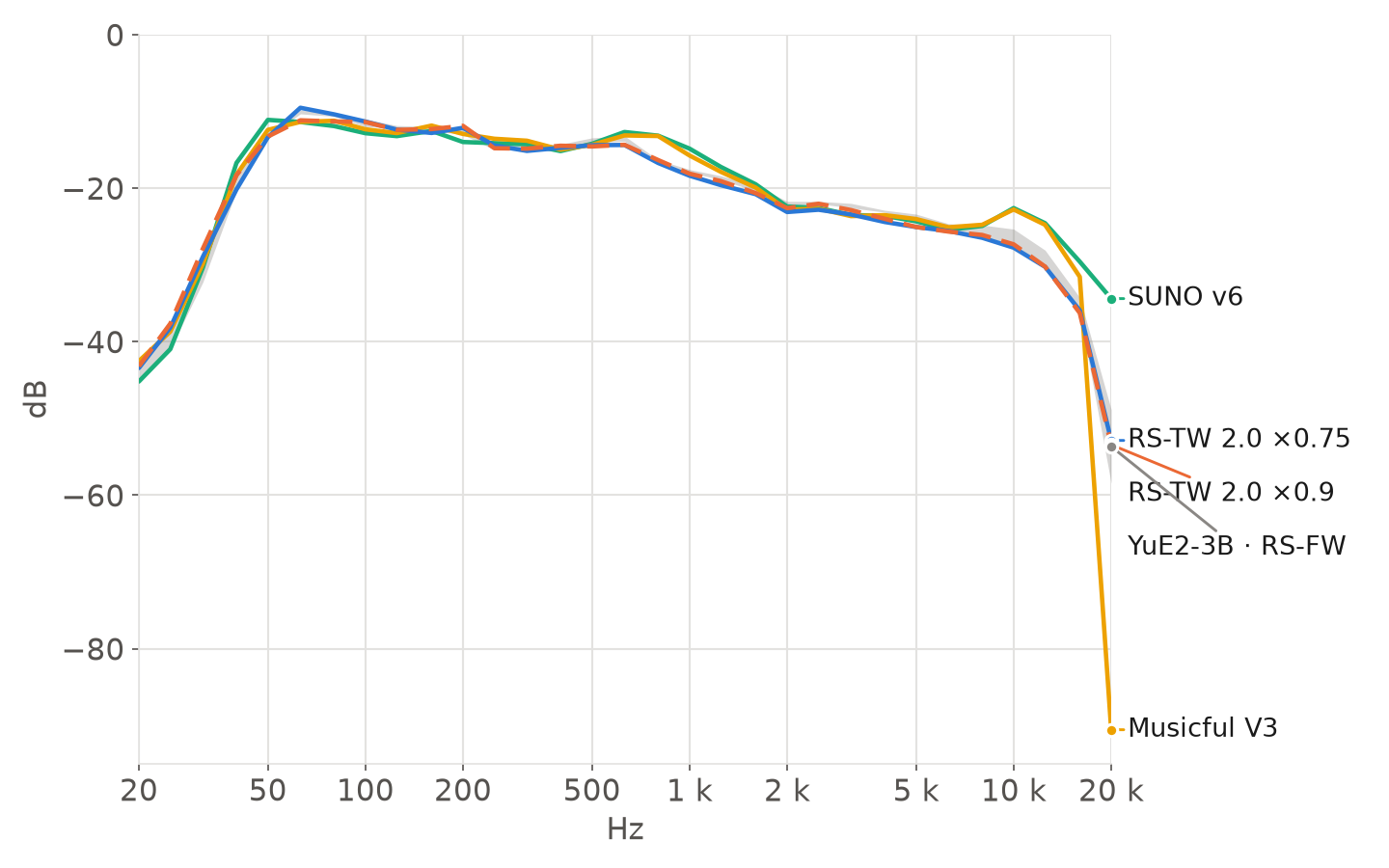
From 100 Hz to 10 kHz the mean curves of all eight sides stay within 5.2 dB of one another. Above 16 kHz they part. Musicful V3 holds nothing past 16 kHz in 38 of its 40 takes: at 20 kHz its mean lies at −90.6 dB, a wall where the others have a slope. SUNO v6 keeps the most up there, −31.0 dB in 16–20 kHz; ours sit at −39.3 to −42.3 dB, and stop at 16 kHz now and then too, in 1 to 6 takes of 40, most often RS-TW 2.0 ×0.9.
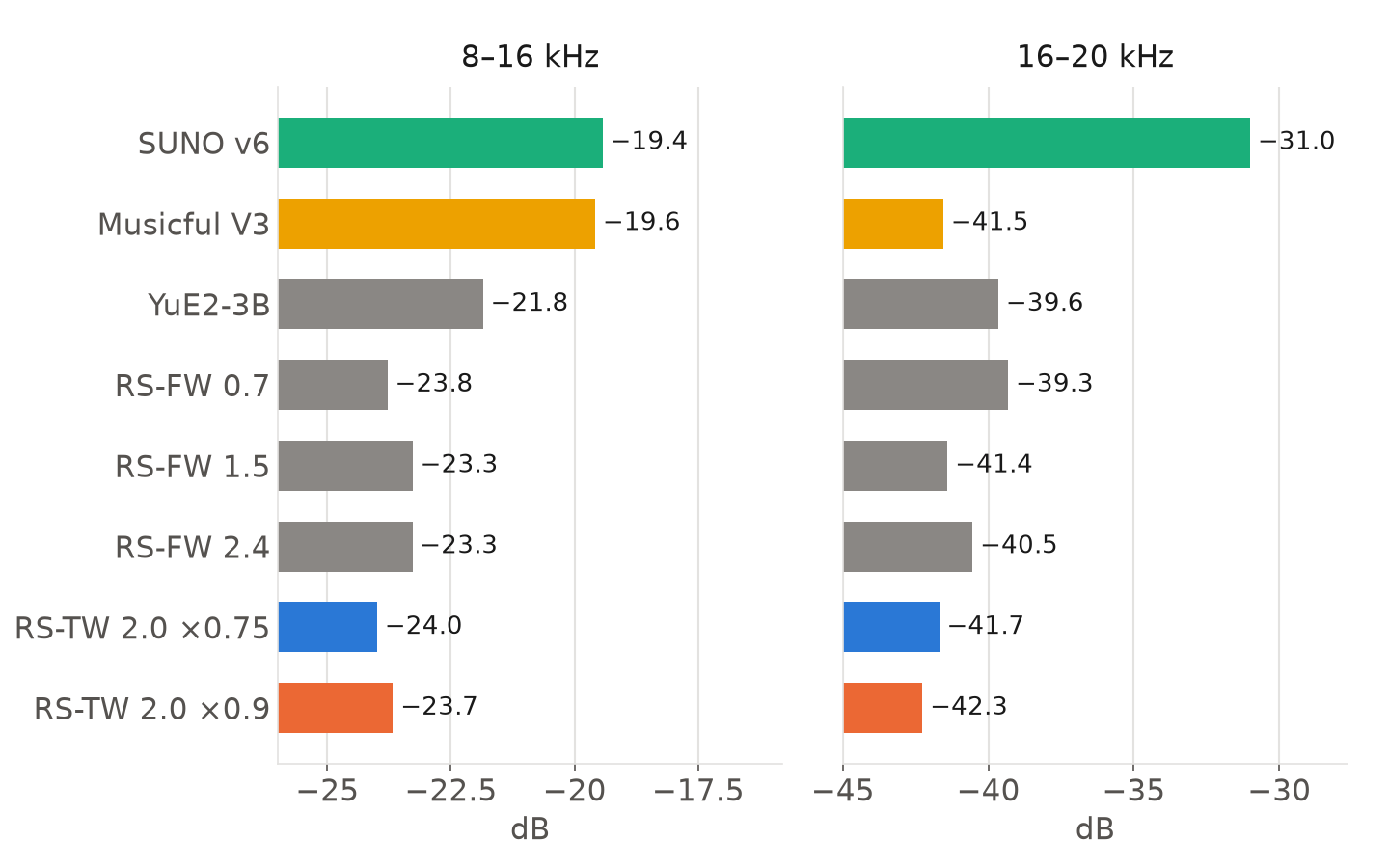
In the air band, 8–16 kHz, SUNO v6 and Musicful V3 sit at −19.4 and −19.6 dB of their takes' power, our six sides at −21.8 to −24.0 dB. A master usually lifts the air, and ours have had none: in the Studio that is the Refiner's to do, once the song is sung.
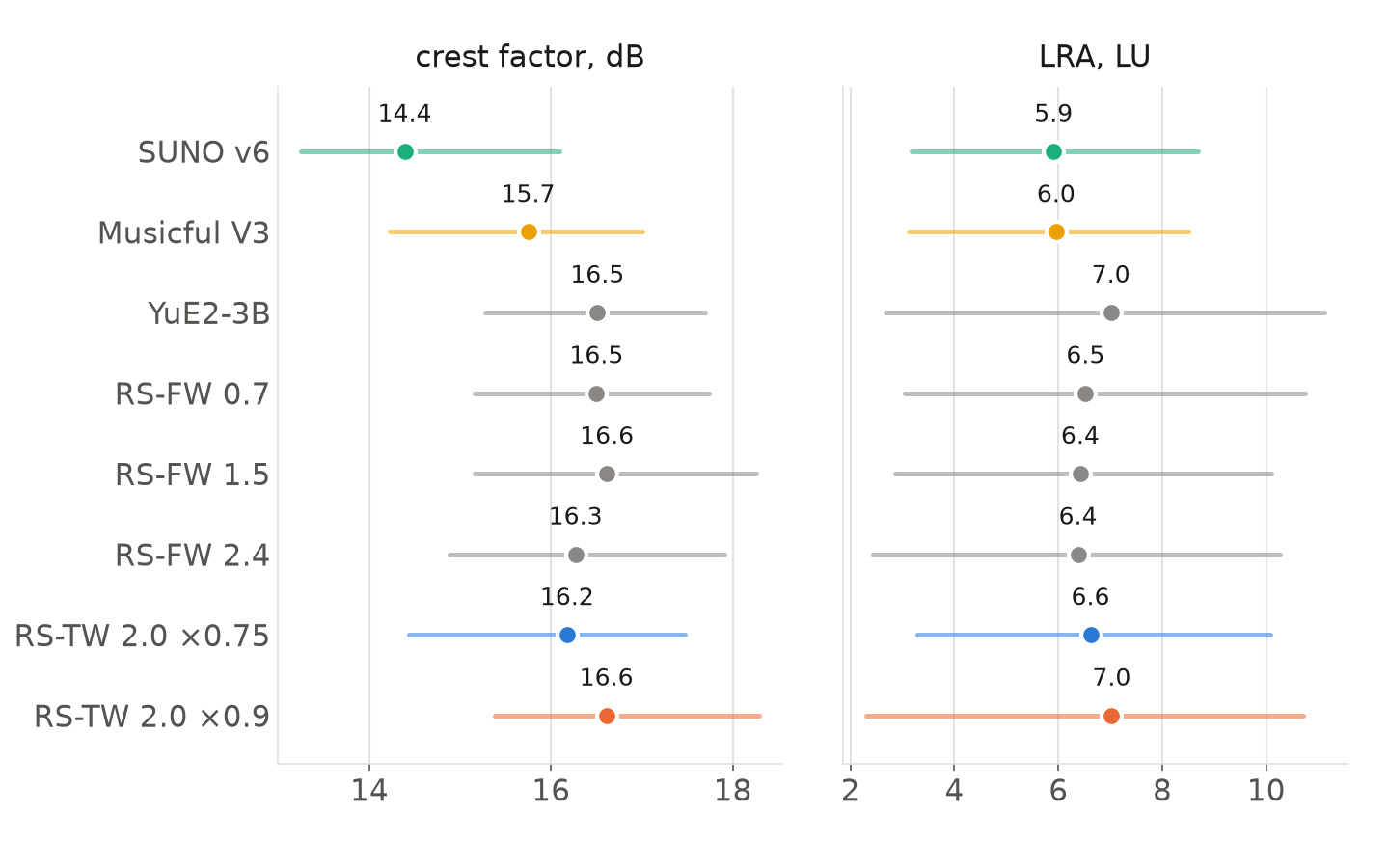
Crest factor, the peak over the average: SUNO v6 14.4 dB, Musicful V3 15.7 dB, ours 16.2 to 16.6 dB. Loudness range: theirs 5.9 and 6.0 LU, ours 6.4 to 7.0 LU. RS-TW 2.0 ×0.9 is the widest of our fine-tunes, 16.6 dB and 7.0 LU, as wide as the stock YuE2-3B (16.5 dB, 7.0 LU): its tectonics, in numbers. ×0.75 is the tighter, 16.2 dB and 6.6 LU.
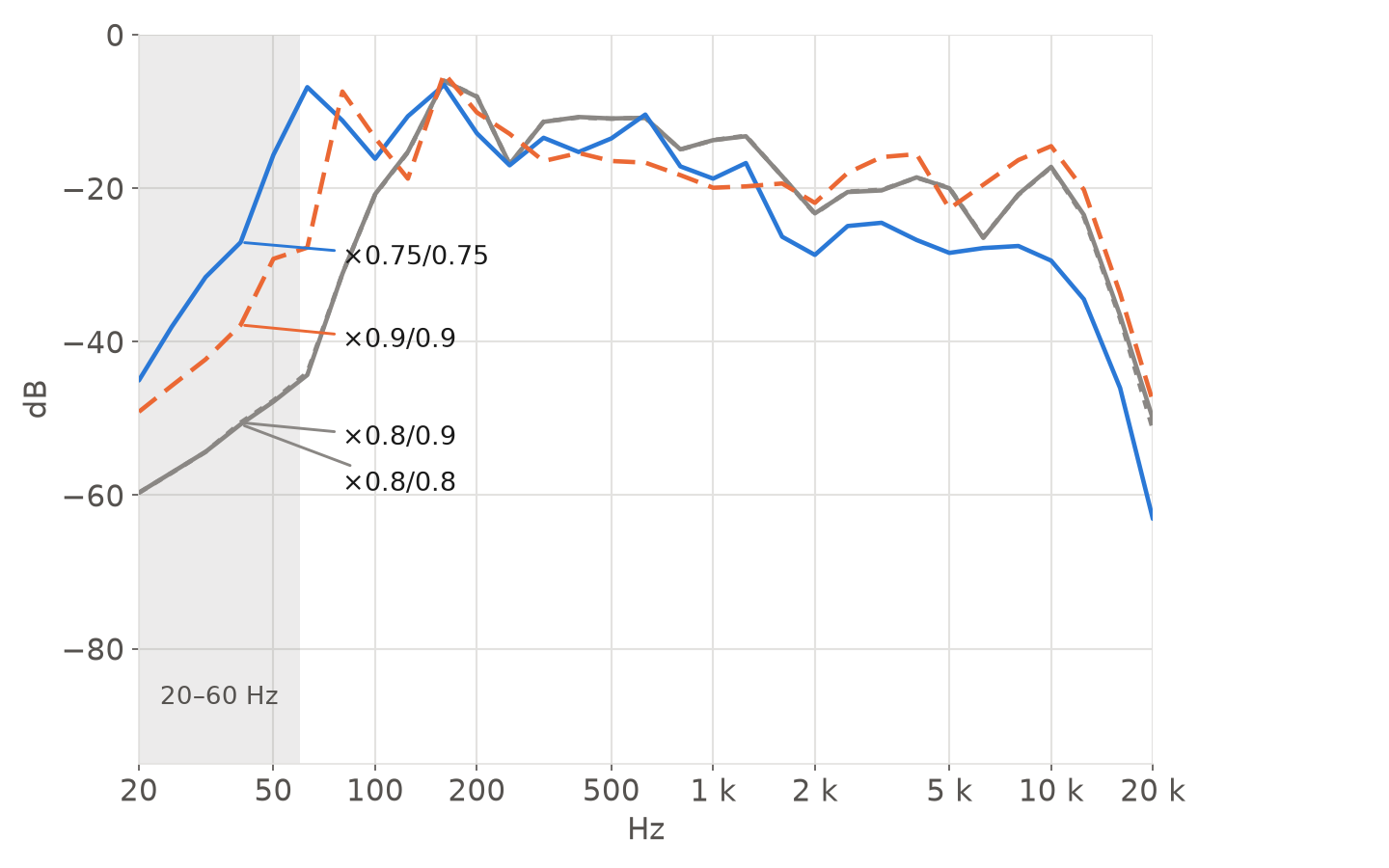
The blind set: twelve cards sung at four strengths of the Tsunami Wave over RS-FW 2.4, the same seed at every strength. On Psalm 22 in Greek, the step from ×0.75/0.75 to ×0.8/0.8 took 36 dB out of the sub-bass, 20–60 Hz, from −7.9 to −44.3 dB: the floor went out from under the song. Across the twelve cards the swing is gentler, the sub-bass at −8.5 dB for ×0.75/0.75 and −10.4 to −11.0 dB for the other three, and ×0.75/0.75 comes closest to the ring's own median curve on 6 cards of 12, a mean distance of 4.1 dB against 4.8 to 5.2 dB. That is why ×0.75 becomes the Studio's default in 2.0.6, and ×0.9 the one that promises no stability.
Measured with our own code on the CPU: 1/3-octave bands from a Welch spectrum, loudness and its range by ITU-R BS.1770-4 and EBU Tech 3342. Each picture opens larger on a click.
The ring's 280 takes, measured for their width. In each of four bands the side, half the difference of the two channels, is set against the mid, half their sum: the higher the side over the mid in dB, the wider that band sounds, and a take in mono would have no side at all. The panorama is how far the difference in level between the left and the right channel swings over a take, from its 5th to its 95th percentile, in dB. Each number is the median of a side's takes, 20 for SUNO v6 and for Musicful V3, 40 for each of ours. Wider is not better here, only wider: this table has no places.
Side over mid in four bands, dB, the medians of each side's takes: the higher, the wider.
| measured raw, the medians | side over mid, dB | panorama, dB | |||
|---|---|---|---|---|---|
| bass 20–200 Hz | mids 0.2–2 kHz | highs 2–8 kHz | air 8–20 kHz | ||
| SUNO v6 | −12.5 | −7.0 | −6.8 | −9.6 | 6.4 |
| Musicful V3 | −13.0 | −7.2 | −5.9 | −7.9 | 6.6 |
| YuE2-3B | −17.4 | −8.2 | −7.9 | −10.6 | 6.4 |
| RS-FW 0.7 | −17.2 | −8.5 | −7.3 | −10.9 | 5.9 |
| RS-FW 1.5 | −17.4 | −7.5 | −6.6 | −10.2 | 6.3 |
| RS-FW 2.4 | −16.5 | −8.0 | −7.9 | −11.2 | 6.4 |
| RS-TW 2.0 ×0.75 | −19.0 | −8.1 | −7.9 | −11.6 | 6.0 |
| RS-TW 2.0 ×0.9 | −20.1 | −8.9 | −8.2 | −12.0 | 5.9 |
Our merges keep the mids and the highs where the stock YuE2-3B has them, none more than 1.3 dB away. RS-TW 2.0 is a little narrower at the edges: ×0.75 by 1.6 dB in the bass, 1.0 dB in the air and 0.4 dB in the panorama, ×0.9 by 2.7, 1.4 and 0.5 dB. SUNO v6 and Musicful V3 open the bass 4.9 and 4.4 dB wider than the stock YuE2-3B.
To Viktor's ear the narrower edges of RS-TW 2.0 sound steadier, not like lost stereo: the stock YuE2-3B often parks a guitar in one channel for 15 to 20 seconds.
Measured with our own code on the CPU: a short-time spectrum of 4096 points every 50 ms over the first 240 seconds of each take, the mid and the side as (L+R)/2 and (L−R)/2, the panorama from the difference in level between the channels in 200 Hz – 8 kHz, in the moments within 40 dB of the take's loudest.
fetch-models.sh); the Artist's models 39–43 GB more, the 💎 sets 5.6 GB, each only when you askNot on free cloud GPUs. Ruach Studio does not run on Google Colab, Kaggle or any free notebook GPU, so don't spend an evening on it there: it is a whole studio, not a notebook. It builds its C++/CUDA engine on the machine it lives on, keeps a server and a lab of Python services running beside it, and takes about 34–41 GB of disk (74–84 GB with the Artist). A free session's card, memory, wiped disk and hours-long limit cannot hold that. It wants your own Linux computer, or a server you rent and keep, with an NVIDIA card: 24 GB for everything, 16 GB with the smaller model copies.
Measured file by file against the pinned lists of the Studio's repositories and on a fresh install's disk (1 GB = 10⁹ bytes). The install brings the Creator, the Librarian and the Refiner's chain; every other room comes only when you ask, from Engine → Models and LoRAs → By room, which measures the free disk first and fetches nothing that would not fit.
| 24 GB card | 12–16 GB card | 8 GB card | |
|---|---|---|---|
| the program and its engine, built here (0.2 GB downloaded) | 0.9 GB | 0.9 GB | 0.9 GB |
| its two Pythons, PyTorch for CUDA 12.8 in each (8.7 GB downloaded) | 16.5 GB | 16.5 GB | 16.5 GB |
| YuE2 and Ruach Studio's own fine-tune, at the card's quant | 14.9 GB | 8.2 GB | 8.2 GB |
| the rest: two more decoders, the transcriber, Whisper, the stems' models, UniverSR and Apollo-vocal, the LoRAs | 8.8 GB | 8.8 GB | 8.8 GB |
| the install | 41.1 GB | 34.4 GB | 34.4 GB |
| + Writer: its language model through llama.cpp | 7.4 GB | 7.4 GB | 6.2 GB |
| + Refiner: MuScriptor and FlashSR | 6.1 GB | 6.1 GB | 6.1 GB |
| + Artist: its helpers and Qwen-Image 2512 (Q6 on 24 GB, Q4 below) | 42.9 GB | 39.3 GB | 39.3 GB |
| + Videographer: MiniMax H3 and SeedVR2 | 86.3 GB | needs 24 GB | needs 24 GB |
| + LoRA Trainer: its base and the style listener | 20.2 GB | 16.3 GB | 12.9 GB |
| every room | 204.0 GB | 103.5 GB | 98.9 GB |
Only when you ask for it by name: the other sound engines (the IRA, IRAE and RS-FW merges, 35 to 86 GB by the quant), the Artist's adapters (7.5 GB) and fine-tunes (20.4 GB each), MiniMax H3's every tier (201 GB) or BF16 (478 GB), the 💎 workspaces (5.6 GB). Not counted: the NVIDIA driver and the CUDA toolkit, Pianoteq (yours to buy), your takes.
2.0.5 is the Studio we make our own songs in every day. These are the larger pieces on their way, for 2.1.0 and after.
Viktor Zhuromskyy, the author of Ruach Studio, does not publish it for the hype. He made it for himself. After more than half a year of struggling with Suno on paid plans, and of searching for a model worth working with (ACE-Step, MiniMax and others), he set out to build an audio studio of his own, on his own machine. He settled on YuE2: of all the open models, it is the best value and the most refined.
He did not knock the Studio together just to have something that runs. He built it his own way, because his creative work is his own too, refined and one of a kind: his translations, his interlinear texts and much more. He fit into it as much as he could, polished the interface as far as he could, and made creating in it not poking and clicking among crutches and potholes, but as productive as it can be.
That is the whole story. Now the Studio is yours as well.
Виктор Журомский, автор Ruach Studio, публикует её не ради хайпа. Он делал её для себя. После более чем полугода мучений с Suno на платных тарифах и поисков достойной модели (ACE-Step, MiniMax и другие) он взялся построить собственную аудиостудию, на своей машине. Выбор пал на YuE2: из всех открытых моделей она самая рентабельная и самая изысканная.
Студию он делал не тяп-ляп, лишь бы работало, а в своём стиле, потому что и творчество у него своё, изысканное и неповторимое: собственные переводы, подстрочники и многое другое. Он постарался вместить в неё максимум, отполировать интерфейс до блеска и сделать творчество в Студии не тыканьем и кликаньем среди костылей и ям, а по-настоящему продуктивным.
Вот и вся история. Теперь эта Студия и ваша.
Віктор Журомський, автор Ruach Studio, публікує її не заради хайпу. Він творив її для себе. Після понад пів року мук із Suno на платних тарифах і пошуків гідної моделі (ACE-Step, MiniMax та інші) він узявся збудувати власну аудіостудію, на своїй машині. Вибір упав на YuE2: з усіх відкритих моделей вона найвигідніша й найвишуканіша.
Студію він творив не абияк, аби лиш працювало, а у своєму стилі, бо й творчість у нього своя, вишукана й неповторна: власні переклади, підрядники та багато іншого. Він намагався вмістити в неї максимум, відшліфувати інтерфейс до блиску, щоб творчість у Студії була не тицянням і клацанням серед милиць і ям, а справді продуктивною.
Ось і вся історія. Тепер ця Студія і ваша.
Віктар Журомскі, аўтар Ruach Studio, публікуе яе не дзеля хайпу. Ён тварыў яе для сябе. Пасля больш як паўгода пакут з Suno на платных тарыфах і пошукаў годнай мадэлі (ACE-Step, MiniMax і іншыя) ён узяўся пабудаваць уласную аўдыястудыю, на сваёй машыне. Выбар упаў на YuE2: з усіх адкрытых мадэляў яна самая выгадная і самая вытанчаная.
Студыю ён тварыў не абы-як, абы працавала, а ў сваім стылі, бо і творчасць у яго свая, вытанчаная і непаўторная: уласныя пераклады, падрадкоўнікі і шмат іншага. Ён стараўся змясціць у яе максімум, адшліфаваць інтэрфейс да бляску, каб творчасць у Студыі была не тыцканнем і клікамі сярод мыліц і ям, а сапраўды прадуктыўнай.
Вось і ўся гісторыя. Цяпер гэтая Студыя і ваша.
Ο Viktor Zhuromskyy, ο δημιουργός του Ruach Studio, δεν το δημοσιεύει για εντυπωσιασμό. Το έφτιαξε για τον εαυτό του. Ύστερα από περισσότερους από έξι μήνες ταλαιπωρίας με το Suno σε πληρωμένα πακέτα, και αναζήτησης ενός μοντέλου που να αξίζει (ACE-Step, MiniMax και άλλα), αποφάσισε να φτιάξει ένα δικό του στούντιο ήχου, στο δικό του μηχάνημα. Κατέληξε στο YuE2: από όλα τα ανοιχτά μοντέλα είναι το πιο συμφέρον και το πιο εκλεπτυσμένο.
Δεν έστησε το Στούντιο πρόχειρα, απλώς για να λειτουργεί. Το έφτιαξε με το δικό του ύφος, γιατί και η δημιουργία του είναι δική του, εκλεπτυσμένη και μοναδική: οι μεταφράσεις του, τα διάστιχα κείμενά του και πολλά άλλα. Προσπάθησε να χωρέσει σε αυτό όσο περισσότερα γινόταν, να γυαλίσει το περιβάλλον ως την τελευταία λεπτομέρεια και να κάνει τη δημιουργία στο Στούντιο όχι άσκοπα κλικ ανάμεσα σε δεκανίκια και λακκούβες, αλλά κάτι πραγματικά παραγωγικό.
Αυτή είναι όλη η ιστορία. Τώρα το Στούντιο είναι και δικό σας.
Viktor Zhuromskyy, el autor de Ruach Studio, no lo publica para llamar la atención. Lo hizo para sí mismo. Tras más de medio año de sufrir con Suno en planes de pago y de buscar un modelo que mereciera la pena (ACE-Step, MiniMax y otros), se propuso construir su propio estudio de audio, en su propia máquina. Se quedó con YuE2: de todos los modelos abiertos, es el más rentable y el más refinado.
No montó el Estudio de cualquier manera, solo para que funcionara. Lo hizo a su estilo, porque su creación también es suya, refinada e irrepetible: sus traducciones, sus textos interlineales y mucho más. Procuró meter en él todo lo posible, pulir la interfaz hasta el último detalle y hacer que crear en el Estudio no sea dar clics a ciegas entre muletas y baches, sino algo de verdad productivo.
Esa es toda la historia. Ahora el Estudio también es tuyo.
Viktor Zhuromskyy, l'autore di Ruach Studio, non lo pubblica per fare clamore. Lo ha costruito per sé. Dopo più di sei mesi di tormenti con Suno sui piani a pagamento, e di ricerche di un modello all'altezza (ACE-Step, MiniMax e altri), ha deciso di crearsi uno studio audio tutto suo, sulla sua macchina. La scelta è caduta su YuE2: fra tutti i modelli aperti è il più conveniente e il più raffinato.
Non ha messo insieme lo Studio alla buona, giusto perché funzionasse. Lo ha fatto a modo suo, perché anche la sua opera creativa è sua, raffinata e irripetibile: le sue traduzioni, i suoi testi interlineari e molto altro. Ha cercato di farci stare il massimo, di rifinire l'interfaccia fino all'ultimo dettaglio e di rendere il creare nello Studio non un cliccare a vuoto tra stampelle e buche, ma qualcosa di davvero produttivo.
Questa è tutta la storia. Ora lo Studio è anche tuo.
Viktor Zhuromskyy, l'auteur de Ruach Studio, ne le publie pas pour faire parler de lui. Il l'a fait pour lui-même. Après plus de six mois à se débattre avec Suno sur des formules payantes, et à chercher un modèle qui en vaille la peine (ACE-Step, MiniMax et d'autres), il s'est mis à construire son propre studio audio, sur sa propre machine. Son choix s'est arrêté sur YuE2 : de tous les modèles ouverts, c'est le plus rentable et le plus raffiné.
Il n'a pas bricolé le Studio à la va-vite, juste pour avoir quelque chose qui tourne. Il l'a fait à sa manière, parce que sa création est la sienne, raffinée et inimitable : ses traductions, ses textes interlinéaires et bien plus encore. Il y a fait entrer tout ce qu'il a pu, a poli l'interface aussi loin qu'il a pu, et a fait de la création dans le Studio non pas un tâtonnement de clics entre béquilles et nids-de-poule, mais quelque chose de vraiment productif.
Voilà toute l'histoire. Maintenant, le Studio est aussi à toi.
Viktor Zhuromskyy, o autor do Ruach Studio, não o publica pelo hype. Ele o fez para si mesmo. Depois de mais de meio ano sofrendo com o Suno em planos pagos, e procurando um modelo que valesse a pena (ACE-Step, MiniMax e outros), ele decidiu construir o seu próprio estúdio de áudio, na sua própria máquina. A escolha caiu no YuE2: de todos os modelos abertos, é o de melhor custo-benefício e o mais refinado.
Ele não montou o Estúdio de qualquer jeito, só para ter algo que rodasse. Fez do seu jeito, porque a criação dele é dele, refinada e inimitável: as suas traduções, os seus textos interlineares e muito mais. Colocou nele o máximo que pôde, poliu a interface até onde pôde e fez da criação no Estúdio não um cutucar e clicar entre muletas e buracos, mas algo de fato produtivo.
Essa é a história toda. Agora o Estúdio também é seu.
Viktor Zhuromskyy, der Autor von Ruach Studio, veröffentlicht es nicht für den Hype. Er hat es für sich selbst gemacht. Nach mehr als einem halben Jahr Mühe mit Suno in bezahlten Tarifen und der Suche nach einem Modell, mit dem sich arbeiten lässt (ACE-Step, MiniMax und andere), machte er sich daran, ein eigenes Audiostudio zu bauen, auf seiner eigenen Maschine. Die Wahl fiel auf YuE2: von allen offenen Modellen das lohnendste und das ausgefeilteste.
Er hat das Studio nicht zusammengeschustert, nur damit irgendetwas läuft. Er hat es auf seine Art gebaut, denn auch sein Schaffen ist sein eigenes, erlesen und unverwechselbar: seine Übersetzungen, seine Interlinearübersetzungen und vieles mehr. Er hat so viel hineingepackt, wie er konnte, die Oberfläche poliert, so weit er konnte, und das Schaffen darin nicht zu einem Stochern und Klicken zwischen Krücken und Schlaglöchern gemacht, sondern zu etwas wirklich Produktivem.
Das ist die ganze Geschichte. Jetzt ist das Studio auch deins.
Ruach Studio の作者 Viktor Zhuromskyy は、話題づくりのためにこれを公開しているのではありません。自分のために作ったのです。有料プランで Suno と半年以上格闘し、取り組むに値するモデルを探し回った末に(ACE-Step、MiniMax ほか)、彼は自分のマシンの上に自分だけのオーディオスタジオを作ろうと決めました。選んだのは YuE2 でした。オープンなモデルの中で、最も割に合い、最も洗練されているからです。
彼は、とりあえず動けばいいという作り方はしませんでした。自分の流儀で作りました。彼の創作は彼自身のもの、洗練された唯一無二のものだからです:自身の翻訳、行間対訳のテキスト、そのほか多くのもの。詰め込めるだけ詰め込み、磨けるだけインターフェースを磨き、スタジオでの創作を、松葉杖と穴ぼこの間を手探りでクリックすることではなく、本当に生産的なものにしました。
話はこれで全部です。これからは、このスタジオはあなたのものでもあります。
Ruach Studio 的作者 Viktor Zhuromskyy 发布它并不是为了炒作。他是为自己做的。在付费套餐上和 Suno 折腾了半年多,又四处寻找值得投入的模型(ACE-Step、MiniMax 等)之后,他决定在自己的机器上搭建一个属于自己的音频工作室。他选定了 YuE2:在所有开放模型中,它最划算,也最精致。
他没有随便拼凑一个能跑就行的工作室,而是按自己的方式来做,因为他的创作也是他自己的,精致而独一无二:他的译本、他的逐行对照文本,还有许多别的。他尽可能多地装进其中,把界面打磨到力所能及的极致,让在这个工作室里的创作不再是在拐杖和坑洼之间胡乱点击,而是真正高效的事。
故事就是这样。现在,这个工作室也是你的了。